Understand the reaction. Change the pattern.
Why did I react like that?
The text you reread six times. The yes you meant as no. This journal takes one moment like that and walks it, step by step, to a plan for next time.The comment that set you off. The “I’m fine” that lasted all evening. Take one moment like that and work it through to a plan for next time, ten minutes at a sitting.
Choose your edition
7 evidence-based steps. One moment at a time.
Pick something small and recent: a reply sent too fast, an evening you went quiet. Then move through it in order. You finish every sitting with something to try.
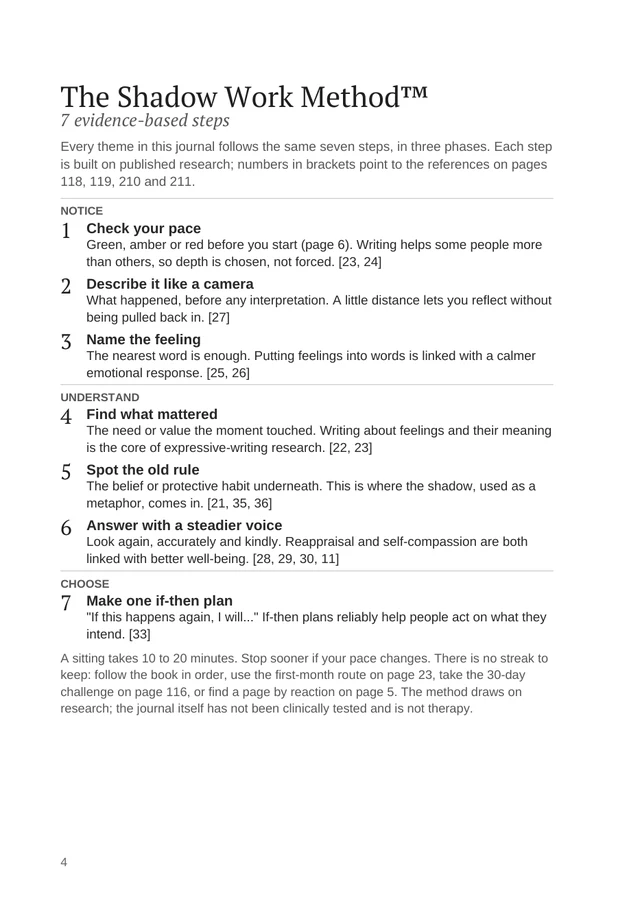
Notice
Steps 1 to 3. Check your pace. Describe the moment like a camera. Name the feeling.
Understand
Steps 4 to 6. Find what mattered. Spot the old rule. Answer with a steadier voice.
Choose
Step 7. One if-then plan to try next time.
The research behind each step
- 1
Check your pace
Writing about emotions helps on average, but not everyone, and not at every moment. Across 146 studies the benefit was small but reliable; in recently separated adults, it slowed recovery for some.
Frattaroli 2006; Sbarra et al. 2013
- 2
Describe it like a camera
Looking back at a hard moment from a little distance lowered distress and helped people find meaning, compared with replaying it from the inside.
Kross & Ayduk 2011
- 3
Name the feeling
In a brain-scanning study, putting a feeling into words reduced amygdala activity in response to emotional faces, a process called affect labeling.
Lieberman et al. 2007; Torre & Lieberman 2018
- 4
Find what mattered
The original expressive-writing studies found benefits when people wrote about both what happened and what they felt about it.
Pennebaker & Beall 1986
- 5
Spot the old rule
Defence mechanisms and early schemas are long-standing ideas about the habits that protect us. The “shadow” is Jung’s metaphor for what we keep out of view; we use it as a lens, not a diagnosis.
Cramer 2000; Young et al. 2003; Jung
- 6
Answer with a steadier voice
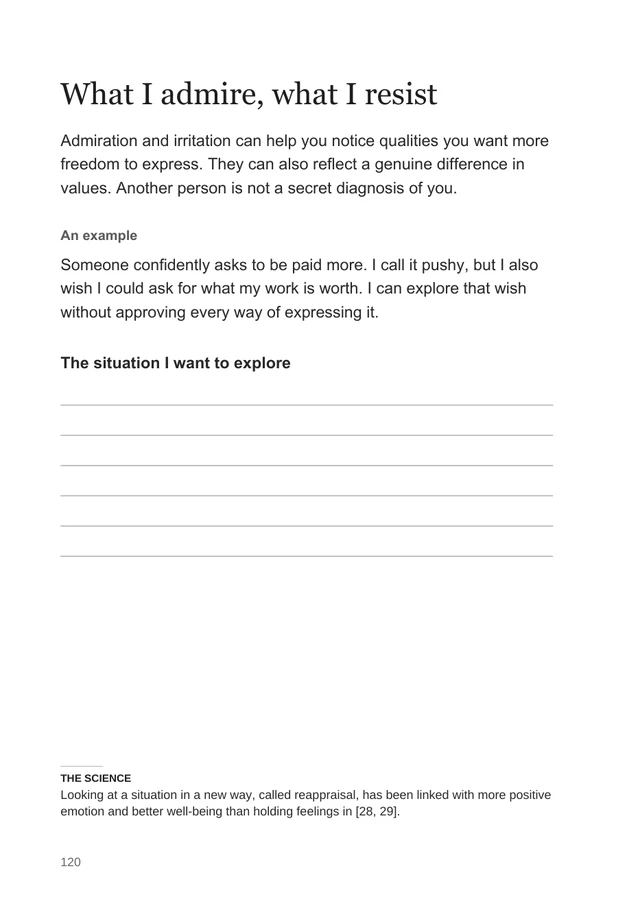
Reappraising a situation is linked with better well-being than suppressing feelings, and self-compassion increased the motivation to improve after a mistake.
Gross & John 2003; Neff 2003; Breines & Chen 2012
- 7
Make one if-then plan
Across 94 tests, “if X, then I will Y” plans had a medium-to-large effect on following through on goals.
Gollwitzer & Sheeran 2006
What the research does not say: that this journal cures, treats or replaces anything. Studies describe averages in particular groups, effects of writing are modest, and the journal itself has not been clinically tested. It is a structured tool for adult self-reflection.
All 50 sources
- Killingsworth, M. A., and Gilbert, D. T. (2010). A wandering mind is an unhappy mind. Science, 330, 932. doi.org/10.1126/science.1192439
- Watkins, E. R. (2008). Constructive and unconstructive repetitive thought. Psychological Bulletin, 134(2), 163 to 206. doi.org/10.1037/0033-2909.134.2.163
- Borkovec, T. D., Alcaine, O. M., and Behar, E. (2004). Avoidance theory of worry and generalized anxiety disorder. In Heimberg, Turk and Mennin (eds.), Generalized Anxiety Disorder: Advances in Research and Practice. Guilford. psycnet.apa.org/record/2004-16375-004
- Baumeister, R. F., Bratslavsky, E., Finkenauer, C., and Vohs, K. D. (2001). Bad is stronger than good. Review of General Psychology, 5(4), 323 to 370. doi.org/10.1037/1089-2680.5.4.323
- Gilovich, T., and Medvec, V. H. (1995). The experience of regret: what, when, and why. Psychological Review, 102(2), 379 to 395. doi.org/10.1037/0033-295X.102.2.379
- Davidai, S., and Gilovich, T. (2018). The ideal road not taken: the self-discrepancies involved in people's most enduring regrets. Emotion, 18(3), 439 to 452. doi.org/10.1037/emo0000326
- Higgins, E. T. (1987). Self-discrepancy: a theory relating self and affect. Psychological Review, 94(3), 319 to 340. pubmed.ncbi.nlm.nih.gov/3615707
- The "golden shadow": Johnson, R. A. (1991). Owning Your Own Shadow. HarperOne. See also IAAP, The Shadow (page 211). iaap.org
- Curran, T., and Hill, A. P. (2019). Perfectionism is increasing over time: a meta-analysis of birth cohort differences from 1989 to 2016. Psychological Bulletin, 145(4), 410 to 429. doi.org/10.1037/bul0000138
- Sirois, F. M., Molnar, D. S., and Hirsch, J. K. (2017). A meta-analytic and conceptual update on the associations between procrastination and multidimensional perfectionism. European Journal of Personality, 31(2), 137 to 159. doi.org/10.1002/per.2098
- Breines, J. G., and Chen, S. (2012). Self-compassion increases self-improvement motivation. Personality and Social Psychology Bulletin, 38(9), 1133 to 1143. doi.org/10.1177/0146167212445599
- Steel, P. (2007). The nature of procrastination: a meta-analytic and theoretical review. Psychological Bulletin, 133(1), 65 to 94. doi.org/10.1037/0033-2909.133.1.65
- Sirois, F., and Pychyl, T. (2013). Procrastination and the priority of short-term mood regulation. Social and Personality Psychology Compass, 7(2), 115 to 127. doi.org/10.1111/spc3.12011
- World Health Organization (2019). Burn-out an "occupational phenomenon": International Classification of Diseases (ICD-11). who.int
- Carleton, R. N. (2016). Fear of the unknown: one fear to rule them all? Journal of Anxiety Disorders, 41, 5 to 21. doi.org/10.1016/j.janxdis.2016.03.011
- Grupe, D. W., and Nitschke, J. B. (2013). Uncertainty and anticipation in anxiety. Nature Reviews Neuroscience, 14(7), 488 to 501. doi.org/10.1038/nrn3524
- de Berker, A. O., et al. (2016). Computations of uncertainty mediate acute stress responses in humans. Nature Communications, 7, 10996. doi.org/10.1038/ncomms10996
- Wittmann, M., and Lehnhoff, S. (2005). Age effects in perception of time. Psychological Reports, 97(3), 921 to 935. doi.org/10.2466/pr0.97.3.921-935
- Friedman, W. J., and Janssen, S. M. J. (2010). Aging and the speed of time. Acta Psychologica, 134(2), 130 to 141. doi.org/10.1016/j.actpsy.2010.01.004
- Avni-Babad, D., and Ritov, I. (2003). Routine and the perception of time. Journal of Experimental Psychology: General, 132(4), 543 to 550. doi.org/10.1037/0096-3445.132.4.543
- Jung, C. G. (1959). Aion: Researches into the Phenomenology of the Self. Collected Works, Vol. 9ii. Princeton University Press. Plain-language summary: Serebrennikova, N., The Shadow, IAAP. The shadow is used in this journal as a reflective concept and metaphor, not a diagnosis or a tested treatment. iaap.org
- Pennebaker, J. W., and Beall, S. K. (1986). Confronting a traumatic event. Journal of Abnormal Psychology, 95(3), 274 to 281. doi.org/10.1037/0021-843X.95.3.274
- Frattaroli, J. (2006). Experimental disclosure and its moderators: a meta-analysis. Psychological Bulletin, 132(6), 823 to 865. doi.org/10.1037/0033-2909.132.6.823
- Sbarra, D. A., Boals, A., Mason, A. E., Larson, G. M., and Mehl, M. R. (2013). Expressive writing can impede emotional recovery following marital separation. Clinical Psychological Science, 1(2), 120 to 134. doi.org/10.1177/2167702612469801
- Lieberman, M. D., et al. (2007). Putting feelings into words. Psychological Science, 18(5), 421 to 428. doi.org/10.1111/j.1467-9280.2007.01916.x
- Torre, J. B., and Lieberman, M. D. (2018). Putting feelings into words: affect labeling as implicit emotion regulation. Emotion Review, 10(2), 116 to 124. doi.org/10.1177/1754073917742706
- Kross, E., and Ayduk, O. (2011). Making meaning out of negative experiences by self-distancing. Current Directions in Psychological Science, 20(3), 187 to 191. doi.org/10.1177/0963721411408883
- Gross, J. J. (1998). The emerging field of emotion regulation. Review of General Psychology, 2(3), 271 to 299. doi.org/10.1037/1089-2680.2.3.271
- Gross, J. J., and John, O. P. (2003). Individual differences in two emotion regulation processes. Journal of Personality and Social Psychology, 85(2), 348 to 362. doi.org/10.1037/0022-3514.85.2.348
- Neff, K. (2003). Self-compassion: an alternative conceptualization of a healthy attitude toward oneself. Self and Identity, 2(2), 85 to 101. doi.org/10.1080/15298860309032
- Leary, M. R., Tate, E. B., Adams, C. E., Batts Allen, A., and Hancock, J. (2007). Self-compassion and reactions to unpleasant self-relevant events. Journal of Personality and Social Psychology, 92(5), 887 to 904. doi.org/10.1037/0022-3514.92.5.887
- Nolen-Hoeksema, S., Wisco, B. E., and Lyubomirsky, S. (2008). Rethinking rumination. Perspectives on Psychological Science, 3(5), 400 to 424. doi.org/10.1111/j.1745-6924.2008.00088.x
- Gollwitzer, P. M., and Sheeran, P. (2006). Implementation intentions and goal achievement: a meta-analysis. Advances in Experimental Social Psychology, 38, 69 to 119. doi.org/10.1016/S0065-2601(06)38002-1
- Oettingen, G. (2012). Future thought and behaviour change. European Review of Social Psychology, 23(1), 1 to 63. doi.org/10.1080/10463283.2011.643698
- Cramer, P. (2000). Defense mechanisms in psychology today. American Psychologist, 55(6), 637 to 646. doi.org/10.1037/0003-066X.55.6.637
- Young, J. E., Klosko, J. S., and Weishaar, M. E. (2003). Schema Therapy: A Practitioner's Guide. Guilford Press. guilford.com
- Hayes, S. C., Wilson, K. G., Gifford, E. V., Follette, V. M., and Strosahl, K. (1996). Experiential avoidance and behavioral disorders. Journal of Consulting and Clinical Psychology, 64(6), 1152 to 1168. doi.org/10.1037/0022-006X.64.6.1152
- Wegner, D. M., Schneider, D. J., Carter, S. R., and White, T. L. (1987). Paradoxical effects of thought suppression. Journal of Personality and Social Psychology, 53(1), 5 to 13. doi.org/10.1037/0022-3514.53.1.5
- Cohen, G. L., and Sherman, D. K. (2014). The psychology of change: self-affirmation and social psychological intervention. Annual Review of Psychology, 65, 333 to 371. doi.org/10.1146/annurev-psych-010213-115137
- Sonnentag, S., and Fritz, C. (2007). The Recovery Experience Questionnaire. Journal of Occupational Health Psychology, 12(3), 204 to 221. doi.org/10.1037/1076-8998.12.3.204
- Crocker, J., and Wolfe, C. T. (2001). Contingencies of self-worth. Psychological Review, 108(3), 593 to 623. doi.org/10.1037/0033-295X.108.3.593
- Tylka, T. L., and Wood-Barcalow, N. L. (2015). What is and what is not positive body image? Body Image, 14, 118 to 129. doi.org/10.1016/j.bodyim.2015.04.001
- Bushman, B. J. (2002). Does venting anger feed or extinguish the flame? Personality and Social Psychology Bulletin, 28(6), 724 to 731. doi.org/10.1177/0146167202289002
- Aron, A., Melinat, E., Aron, E. N., Vallone, R. D., and Bator, R. J. (1997). The experimental generation of interpersonal closeness. Personality and Social Psychology Bulletin, 23(4), 363 to 377. doi.org/10.1177/0146167297234003
- Gottman, J. M., and Levenson, R. W. (1992). Marital processes predictive of later dissolution. Journal of Personality and Social Psychology, 63(2), 221 to 233. doi.org/10.1037/0022-3514.63.2.221
- Mani, A., Mullainathan, S., Shafir, E., and Zhao, J. (2013). Poverty impedes cognitive function. Science, 341(6149), 976 to 980. doi.org/10.1126/science.1238041
- Wrzesniewski, A., McCauley, C., Rozin, P., and Schwartz, B. (1997). Jobs, careers, and callings. Journal of Research in Personality, 31(1), 21 to 33. doi.org/10.1006/jrpe.1997.2162
- Schwartz, B., et al. (2002). Maximizing versus satisficing: happiness is a matter of choice. Journal of Personality and Social Psychology, 83(5), 1178 to 1197. doi.org/10.1037/0022-3514.83.5.1178
- Lally, P., van Jaarsveld, C. H. M., Potts, H. W. W., and Wardle, J. (2010). How are habits formed. European Journal of Social Psychology, 40(6), 998 to 1009. doi.org/10.1002/ejsp.674
- Emmons, R. A., and McCullough, M. E. (2003). Counting blessings versus burdens. Journal of Personality and Social Psychology, 84(2), 377 to 389. doi.org/10.1037/0022-3514.84.2.377
A look inside
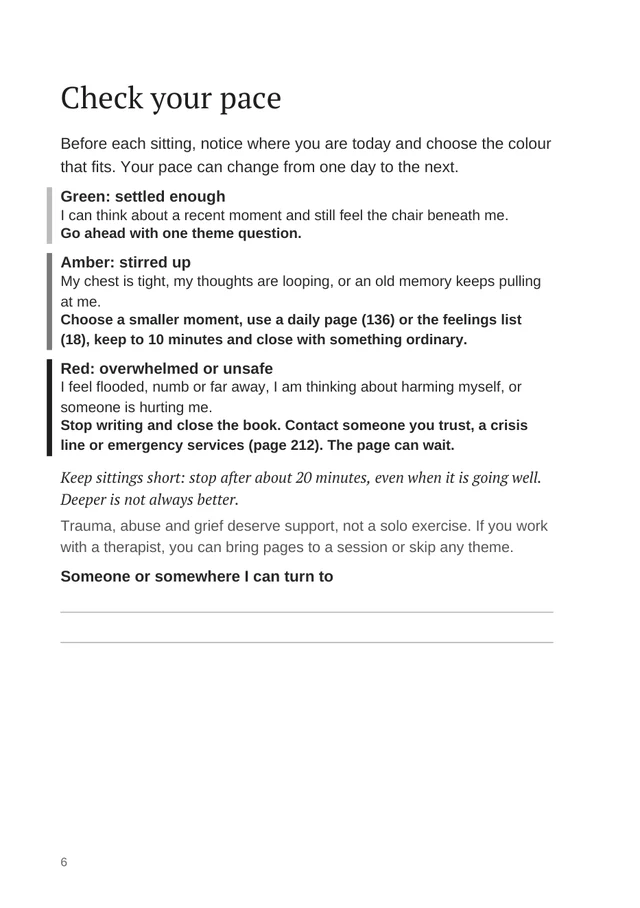
Most pages are for writing. Worked examples show you what an answer can look like; bullet points are fine.
Free to take · about 8 minutes · full results $7
What’s your shadow pattern?
Six patterns many women will recognize. Which one runs your hard days?Six patterns many men will recognize, even if they never say so. Which one runs yours?
The collection
Nothing is on sale yet. Join the waitlist and you will hear first, with the free 30-day challenge in the meantime.
Gift Edition
Paperback, 31-card prompt deck, full quiz result and the 30-day challenge.
Full quiz results
Your complete pattern report, beyond the short result.
Print copies ship at the buyer’s cost and do not ship to Russia. Digital products carry a 30-day refund.
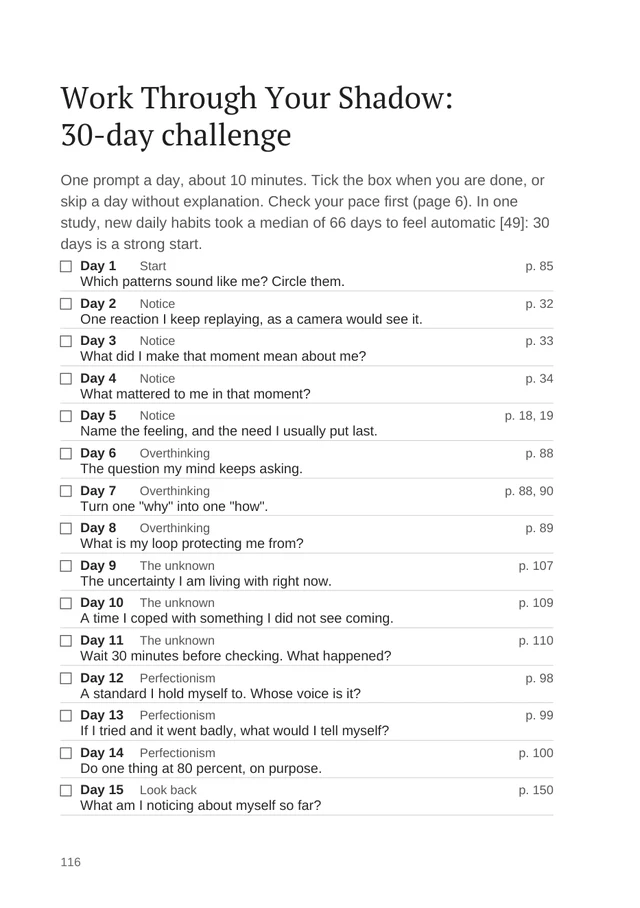
The free 30-day challenge
One prompt a day, about ten minutes, with a printable tracker.
Then one email a week at most. Unsubscribe anytime. Adults only (18+).
Questions
Is this therapy?
No. It is a journal for adult self-reflection and does not replace professional care. Plenty of people use it alongside therapy. It is not designed for working through trauma alone.
I have never done shadow work. Where do I start?
With something small that happened this week, not your childhood. Every sitting opens with a pace check, and you can stop on any page.
Is the quiz free?
Taking it is free, and you see your main pattern and scores straight away. The full results, with a 7-day prompt set and a printable PDF, cost $7 and open at launch.
Is it based on research?
The steps draw on studies of expressive writing, naming feelings, self-distancing, reappraisal, self-compassion and if-then plans. “Shadow” is Jung’s metaphor, used as a lens. The journal itself has not been clinically tested.
Where do print copies ship?
UK $5.99, US $7.99, elsewhere $16.99, added at checkout. Print copies do not ship to Russia; the PDF is available there.
Write to us
Questions, wholesale, press, or a page that landed. We read everything and reply within a few days.